
Key Grammar points
The Conditional
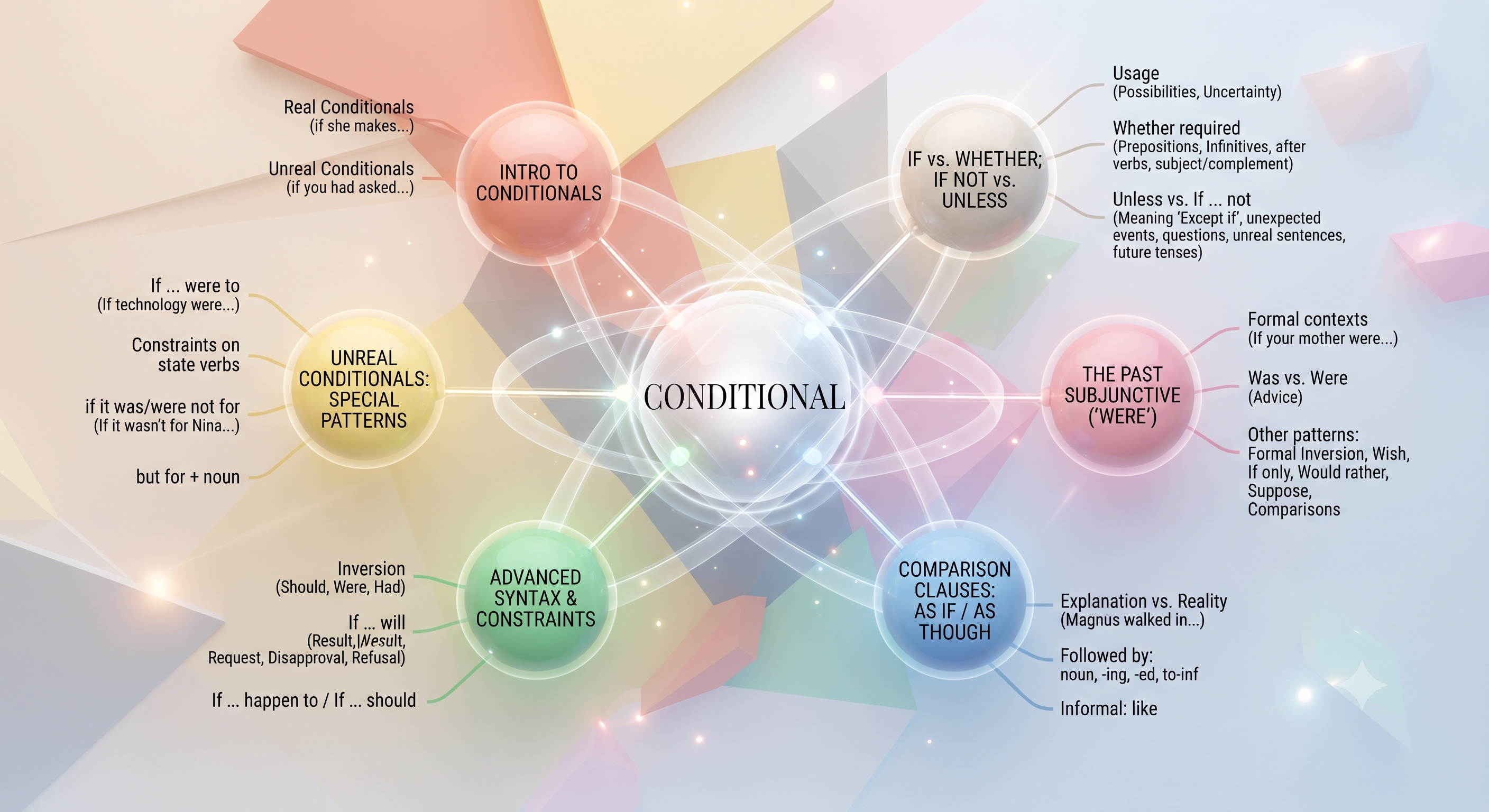 .
.
1. Introduction to Conditionals
-
Definition: A conditional sentence contains a conditional clause. While usually starting with ‘if’, other patterns exist (e.g., Had it not rained, Spain would have won).
-
Real Conditionals: Suggest the situation is/was true, or may have been/may become true.
-
Example: If she makes a promise, she keeps it.
-
-
Unreal Conditionals: Suggest the situation is imaginary or untrue.
-
Example: If you had asked me, I would have helped.
-
2. Unreal Conditionals: Special Patterns
A. "If ... were to"
Used for imaginary future situations, particularly when it is unlikely.
-
Example: If the technology were to become available, we would be able to expand the business.
-
Note: Do not use this pattern with state verbs (belong, doubt, enjoy, know, like, remember, understand).
-
Incorrect: If I were to know they were honest...
-
Correct: If I knew they were honest, I’d gladly lend them the money.
-
-
Politeness: This pattern can make a suggestion sound more polite.
B. "If it was/were not for" & "But for"
Used to say one situation is dependent on another or a person.
-
Standard: If it wasn’t / weren’t for Nina, the conference wouldn’t be going ahead.
-
Past: If it hadn’t been for Dad, I wouldn’t have gone to college. (or If it wasn’t / weren’t for...)
-
Formal: Were it not for... or Had it not been for...
-
Alternative: But for + noun phrase.
-
Example: The village school would have been closed years ago but for the determination of teachers and parents.
-
3. Advanced Syntax & Constraints
A. Inversion (Removing 'If')
In formal or literary hypothetical conditionals, you can omit 'if' and place the verb at the start:
-
Should any of this cost you anything, send me the bill.
-
It would be embarrassing, were she to find out the truth.
-
Had they not rushed Jo to hospital, she would have died.
B. The Use of "If ... will"
Normally not used in conditional clauses, but exceptions apply:
-
Result: When talking about the result of the main clause.
-
Open a window if it will help you to sleep. (Compare: I will be angry if it turns out that you are wrong.)
-
-
Requests/Willingness: Meaning "if you are willing to" (or would for politeness).
-
If you will / would take your seats, we can begin.
-
-
Disapproval: Real conditionals showing annoyance (will is stressed).
-
If you will go to bed so late, I’m not surprised [you are tired].
-
-
Refusal: Using if ... won't.
-
There’s no point trying to teach the class if they won’t pay attention.
-
C. "If ... happen to" / "If ... should"
Used to talk about something possible but unlikely. If ... happen to is most common in speech.
-
If you happen to be in our area, drop in and see us. (or If you should [happen to] be...)
-
Note: Not used for highly unlikely/impossible states (e.g., If the North Sea froze in winter...).
4. Comparison Clauses: "As If" and "As Though"
Used to explain or suggest something appears to be the case when it is not. Followed by noun phrases, -ing clauses, past participles, or to-infinitives.
-
Magnus walked in as if nothing had happened.
-
When he caught the ball, Lee fell to the floor as if hit by a bullet.
-
As if to convince herself that Luis was really there, she gently touched his cheek.
-
Notes: As though can replace as if. Informally, like is sometimes used.
5. The Past Subjunctive ("Were")
Were can be used with any subject (I/she/he/it). It is formal and refers to the imaginary present/future.
-
If your mother were here, I’m sure she wouldn’t let you eat all those chocolates.
-
My job would not exist if it were not for government funding.
-
Note: Was is acceptable, but If I were you is preferred when giving advice.
"Were" in Other Patterns
-
Formal Inversion: Were the election to be held today...
-
After 'Wish': I wish it were closer to home.
-
After 'If only': If only it were that simple.
-
After 'would rather/sooner': I’d sooner it were earlier.
-
After 'Suppose/Supposing/Imagine': Suppose I were to lower the price...
-
Comparisons: After as if, as though, and even if: ...as if it were yesterday.
6. If vs. Whether; If ... Not vs. Unless; If vs. Whether
-
Use either when discussing two possibilities or uncertainty.
-
Whether is required:
-
After a preposition.
-
Before a to-infinitive.
-
In the pattern noun/adjective + as to whether.
-
After verbs: advise, choose, consider, depend on, discuss, talk about, think about.
-
In a clause acting as a subject or complement.
-
-
Whether or not: Can be used together (Whether or not Aya was coming).
If ... Not vs. Unless
-
Unless means "except if."
-
Use if ... not (not unless):
-
When the main clause outcome is unexpected.
-
Usually in questions.
-
When the "only if" implication does not apply.
-
In unreal conditional sentences (though unless works if the main clause is negative).
-
-
Grammar rule: Use present tenses with unless when referring to the future.