
Cash flow statement
Cash flow statement
A. Cash inflows and outflows
Remember that under the accruals method (in the lesson Profit and Loss Account), events in a particular reporting period are recorded in that period, rather than when the money is actually received or paid out, which may happen in a later period. And depreciation (see previous lessons) represents reductions in the values of the firm's equipment, etc. although no actual cash leaves the company, of course.
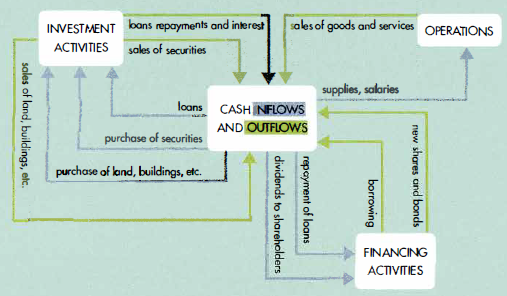
However, the cashflow statement shows cash inflows and outflows - money actually coming into and going out of a company in a particular period.
A company can have cashflow problems even if it is profitable, for example if it is paying suppliers more quickly than it is being paid by customers. This is related to the credit terms that businesses have. In the UK, there is usually an agreed credit period of 30 days or more in which invoices must be paid. In some countries, this period is much longer.
Note
The forms cashflow, cash-flow and cash flow are about equally frequent
B. Types of cashflow
Net cashflow from operations is the money generated by the sales of the company's goods or services, minus the money spent on supplies, staff salaries, etc. in the period.
Net cashflow from investment activities is the overall result of the following:
- inflows - loans repaid and loan interest paid by borrowers; money received from sales of securities in other companies; sales of land, buildings and equipment
- outflows - loans made to borrowers; purchases of securities in other companies; purchases of land, buildings and equipment
Net cashflow from financing activities is the result of the following:
- inflows - money received through issuing new shares and bonds in the company; money received through short-term borrowing
- outflows - money repaid in short-term borrowing; dividends paid to shareholders
Adding and subtracting the figures above, the company calculates its net cash position at the end of the year. Investors check the cashflow statement to see how the company has obtained and used cash - how much it has made from its operations, raised through new share issues, etc.
Reading comprehension
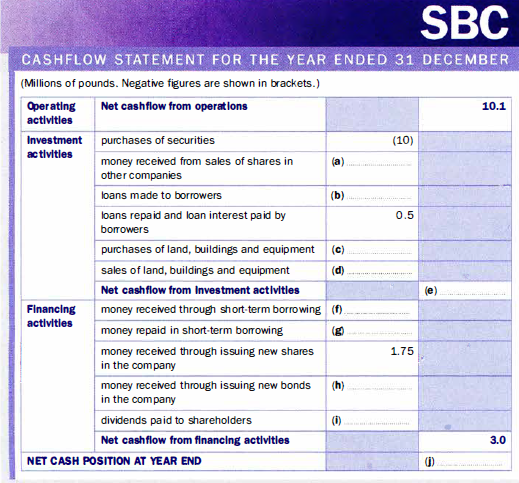
1. Use the information of the lesson plus the facts from the presentation below to complete the table about a fictional UK company called SBC.
Last year, SBC had a net cashflow from its operations of £10.1 million. It bought a new office building for £8 million and new equipment for £1 million. The company lent £1 million to one of its directors so that she could buy a new house. SBC paid £10 million to buy shares in Company A and obtained £6 million for shares that it sold in Company B.
It received interest of £500,000 on a loan it had made to another director and sold its old office building for £5 million.
SBC obtained a bank loan for £500,000 that it will have to repay next year. It paid out £1 million in dividends to shareholders. It raised £1.25 million by issuing new bonds and £1.75 million by issuing new share capital. It also repaid a loan of £1.5 million that it obtained last year.
Over to you
What are typical credit terms in your country or other countries that you know?
……………………………………………………………………………………………………………………………………………………..
Answers:
1. a. 6 f. 0.5
b. (1) g. (1.5)
c. (8) h. 1.25
d. 5 i. 1
e. (7.5) j. 5.6
Over to you (sample answer)
Credit terms in Germany and Sweden are quite short - 30 days is normal, with interest payable after that time. But in southern Europe – Spain and Italy, for example - they can be up to 120 or even 150 days.