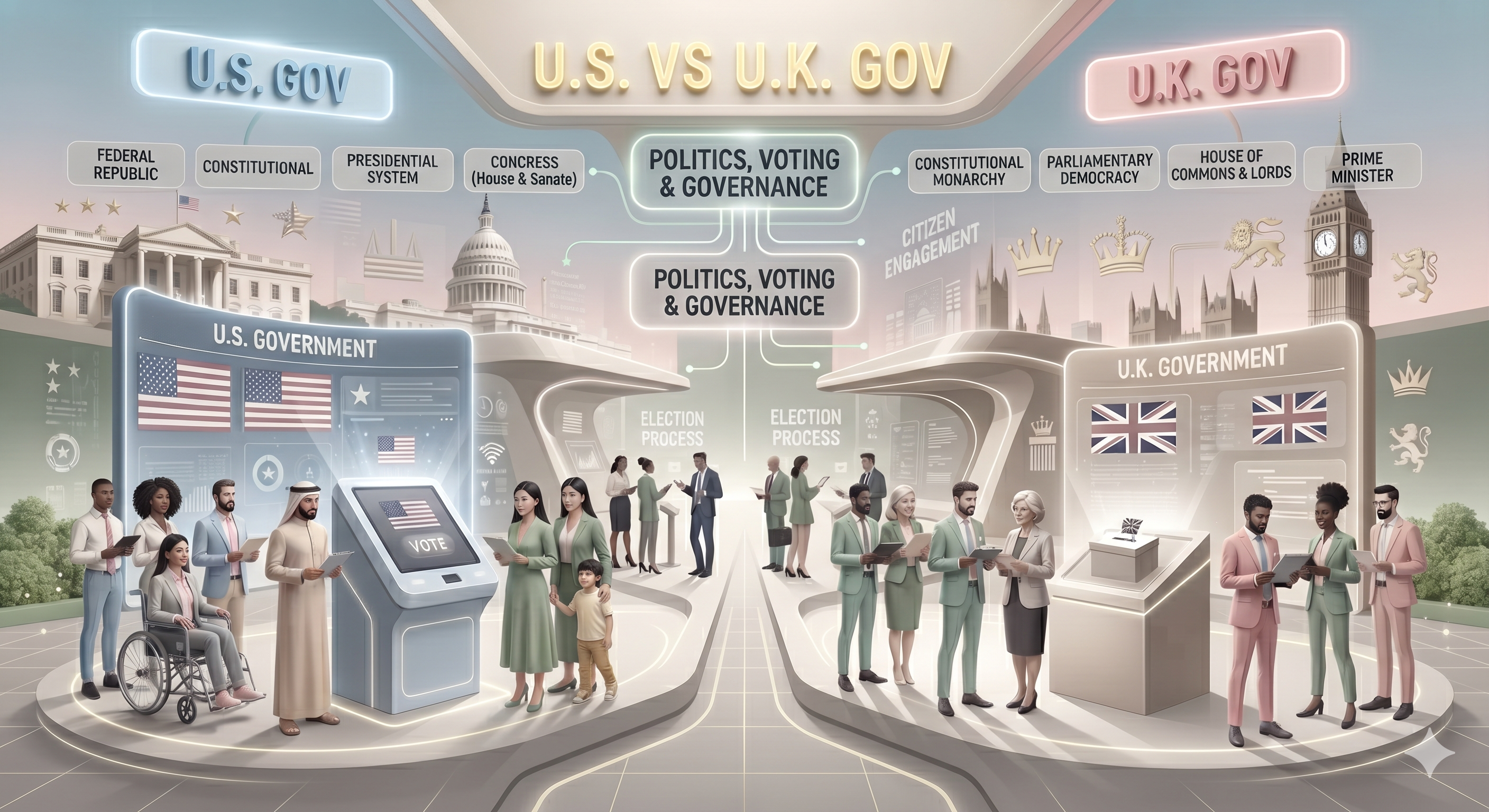
Unit 5: Politics, Voting, and Government (Part I). Dr BOULIFA.H.
الخطوط العريضة للقسم
Brief Description
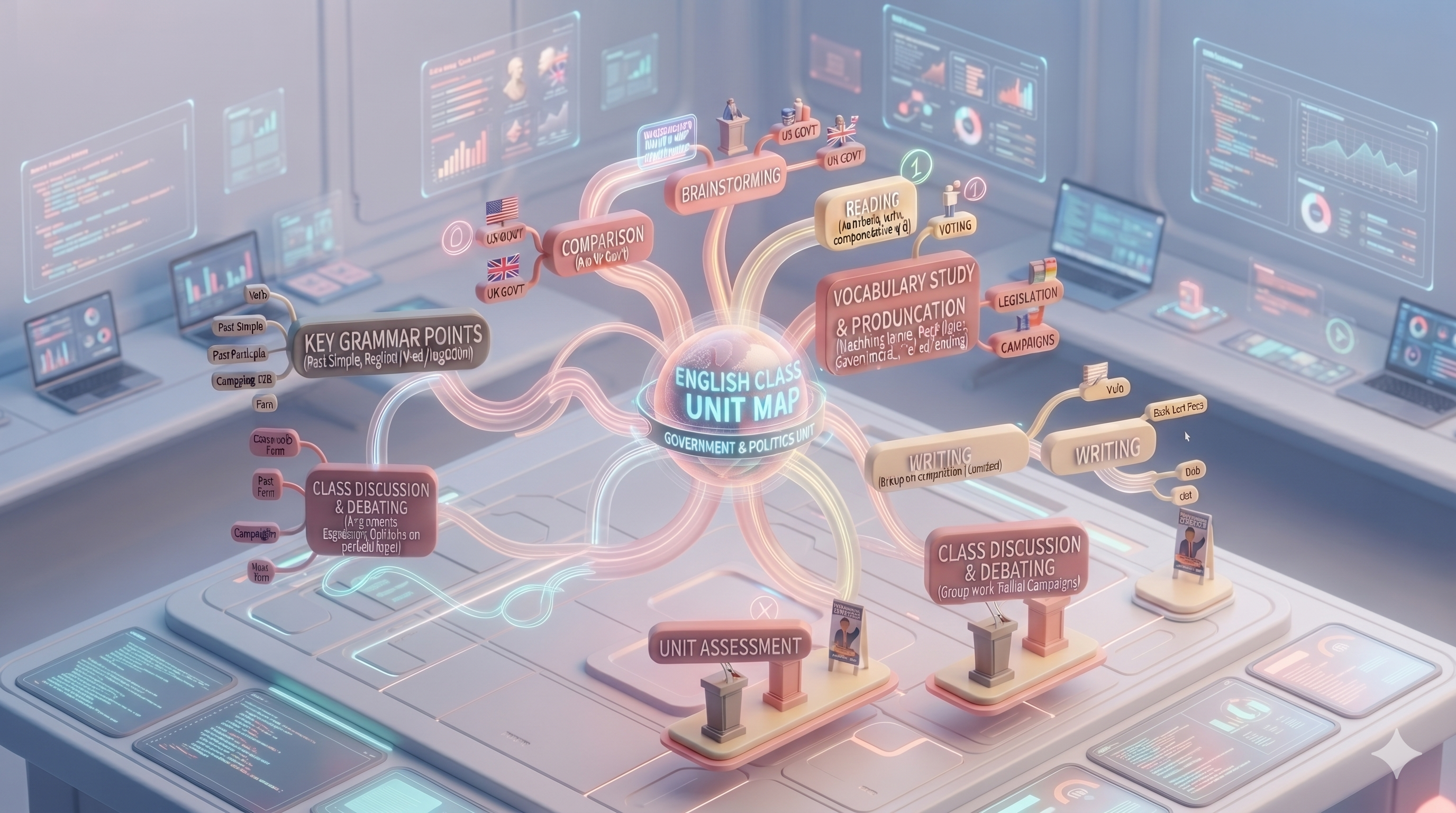
This unit introduces ENS students to American and British governments through several parts: comparison, reading, vocabulary study, pronunciation, writing, key grammar, class discussion, debating, and unit assessment. Students will develop their language skills while understanding and discussing political systems in English.
Target Audience
This unit is designed for HNS students studying English. It is suitable for learners who need to develop political vocabulary and basic understanding of English-speaking political systems
By the end of this unit, learners will be able to identify, understand, compare, and analyze basic features of American and British governments. They will also be able to use and pronounce key political vocabulary correctly.
Watch the two videos about how the UK government and the U.S. government work. Then, compare both political systems by identifying their main similarities and differences. Present your answer in a brief, clear, and well-organized academic paragraph or table.
COMPARISON
The UK and the United States are both democratic countries, but their governments are organized in different ways. The following comparison explains the key similarities and differences between the two systems, focusing on leadership, law-making, elections, and the division of power.
1. Similarities
Both videos explain that government is organized to manage the country, make laws, and protect citizens’ rights. In both systems, citizens participate through elections, choosing representatives who take part in political decision-making.
Both countries also have a law-making institution: the UK has Parliament, while the U.S. has Congress. These institutions debate national issues, create laws, and control public spending. In addition, both systems include mechanisms that prevent one person or group from holding unlimited power. The UK uses parliamentary scrutiny, while the U.S. uses a formal system of checks and balances.
2. Differences
The main difference is the structure of power. In the UK, the Prime Minister leads the government and is usually the leader of the party with the most seats in the House of Commons. The monarch has a constitutional and mostly ceremonial role.
In the U.S., power is clearly divided into three separate branches: the legislative branch, the executive branch, and the judicial branch. The President is both head of state and head of government, while Congress makes laws and the courts interpret them.
Another difference concerns the relationship between the executive and the legislature. In the UK, the government comes from Parliament, so the Prime Minister and ministers are usually also members of Parliament. In the U.S., the President is elected separately from Congress, which creates a stronger separation between the executive and legislative powers.
In brief, both videos show that the UK and the U.S. are democratic systems based on representation, elections, and law-making. However, the UK system is parliamentary and linked to the monarchy, while the U.S. system is presidential and based on a strict separation of powers.

 Brief Description